Un article du Blog Switzerland and the First World War présente les exportations de munitions suisses durant la Première Guerre mondiale en direction des pays de l’Entente et des Empires centraux.
Les ventes aux Pays de l’Entente (France, Grande-Bretagne, Etats-Unis) furent 32 fois plus importantes que les exportations pour les Empires centraux d’août 1916 à février 1917 et du double d’août 1917 à janvier 1918.
Hang on! Switzerland was neutral during the First World War. What were the Swiss doing, making artillery shells? Well, international law allowed a neutral to trade with both sides. More than that, the Swiss were not simply taking advantage of the war to make a profit. The Allies armies needed as many shells as they could get, and those from Switzerland were a significant contribution.
The Swiss branch of the British Ministry of Munitions opened an office in Berne, Switzerland, in September 1915. Weeks before that, the British had signed a contract with a Swiss manufacturer for
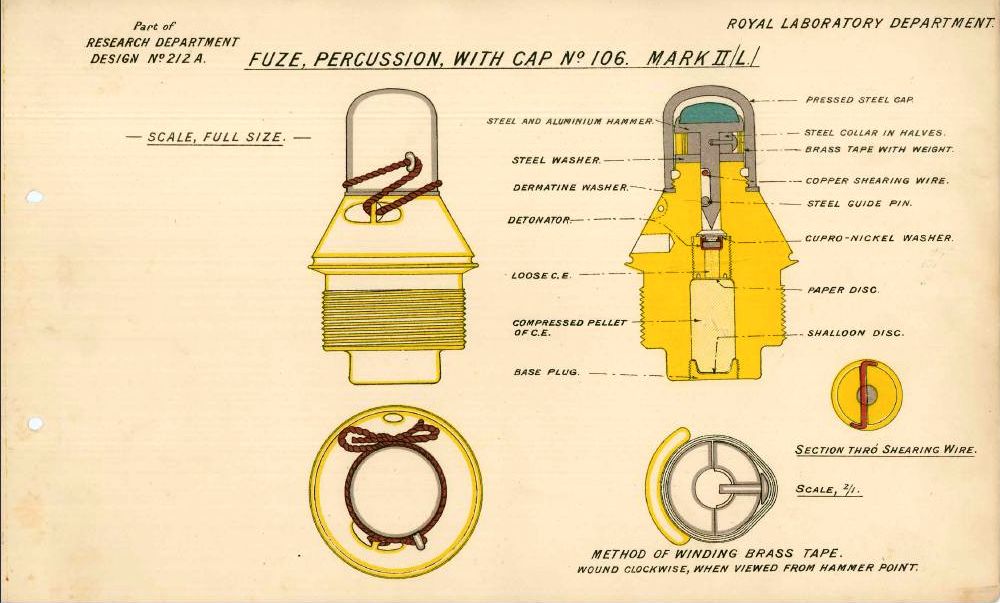
100,000 units of the No.100 type artillery fuses per week, over 26 weeks: the first of many orders. In September 1916 the Allies placed a contract for 5.2 million units of the No.106 fuse.
By the end of the First World War, the Swiss had made over 25 million artillery shell fuses for the British, as well as over 121 million components used in assembling other fuses. These were precision parts that required skilled labour. After the Italian entry into the war, that country also bought munitions from the Swiss.
This work required considerable raw materials, but Switzerland’s natural resources were limited and she depended on trade to obtain many such supplies. For example, the Swiss imported brass for making the No.106 fuse from the USA, and steel from the UK.
In an attempt to stop this trade, the Germans created a “black list” of manufacturers making munitions for the Entente (France, the UK and allies), to ensure that they could not obtain coal, steel or iron from Germany (which was the main source of these materials for Swiss factories). Swiss firms and the Swiss government tried to evade these measures, and the Germans renegotiated this agreement at later dates. For the flow of trade in the other direction, the Société Suisse de Surveillance économique was established to ensure that no metal which had been supplied to the Swiss for the production of fuses for the Entente, was sent to the Central Powers instead.
 Above: left to right, the shell, No.106 Mk II fuse and safety cap for a British 18-pounder field gun. This was one of the types of fuses supplied by the Swiss to the Entente armies.
Image source: « Mili14 » at collections.delcampe.net
La qualité et la fiabilité des munitions suisses apparaissent comme étant élevées dans un rapport rédigé en 1918 par un inspecteur anglais, notamment dans les manufactures de Genève et du Locle.
“In Switzerland there are whole districts such as Geneva and Le Locle whose industries are watchmaking, and whose people are therefore hereditarily trained to most accurate work. Fortunately these districts are French-speaking, and very pro-Entente. Large contracts were placed in both these districts with extremely satisfactory results… The fuzes produced by them on a very large scale gave complete satisfaction, and the rejects were only a very small percentage of the whole.”
Comme indiqué, le fait que ces manufactures horlogères soient citées dans la partie francophone de la Suisse joua en faveur des pays de l’Entente. Indirectement, ce passage met en lumière les fractures entre la Suisse romande et la Suisse alémanique durant le conflit. Les premiers prenant partie pour les pays de l’Entente et les seconds pour les Empires centraux. En 14-18, la Suisse fut divisée comme rarement.
Sources de l’article : UK National Archives, MUN 5/321B/28 and MUN 4/2026.
(Via www.switzerland1914-1918.net)
En savoir plus sur histoire lyonelkaufmann
Subscribe to get the latest posts sent to your email.
Laisser un commentaire